The animal bones at Warratyi Rock Shetler are highly diverse and very well preserved. During excavations at the shelter, archaeologists collected hundreds of bones and bone fragments from wallabies, kangaroos, native rodents, marsupial carnivores, reptiles and megafauna. Faunal analyses are ongoing, but we have described which species were found in the deposit, what condition they are in, how they have been burnt, and how these change over time.
Identification
The bones from Warratyi were compared to skeletons and descriptions of other animals to decide which species they were. Researchers from the South Australian Museum and Flinders University were able to identify 317 individual skeletal elements, but all the other remains were too fragmented to know which bones they were from. Most of the identified bones were from kangaroos and wallabies, but it was not always possible to distinguish between species. The animals identified from bones at Warratyi are:
- Dasyurus viverrinus (Eastern quoll)
- Sarcophilus harrisii (Tasmanian Devil)
- Dirprotodon optatum (Yamuti)
- Lagorchestes hirsutus (Rufous hare-wallaby)
- Macropus fuliginosus (Mandya, Western Grey kangaroo)
- Onychogalea fraenata (Bridled nail-tail wallaby)
- Onychogalea lunata (Crescent nail-tail wallaby)
- Osphranter robustus (Euro)
- Osphranter rufus (Red kangaroo)
- Petrogale xanthopus (Andu, Yellow-footed rock wallaby)
- Bettongia lesueur (Boodie bettong)
- Perameles bougainville (Western barred bandicoot)
- Isoodon auratus (Golden bandicoot)
- Macrotis lagotis (Warda, Greater bilby)
- Leporillus apicalus (Lesser stick-nest rat)
- Leporillus conditor (Great stick-nest rat)
- Notomys amplus (Short-tailed hopping mouse)
- Notomys longicaudatus (Long-tailed hopping mouse)
- Pseudomys australis (Plains rat)
- Pseudomys gouldii (Gould’s mouse)
- Pseudomys shortridgei (Heath mouse)
- Rattus fuscipes (Bush rat)
- Rattus villosissimus (Long-haired rat)
- Venomous (elapid) snake
- Tiliqua rugosa (Shingleback lizard)
Just over half of the remains uncovered at Warratyi are from kangaroos and wallabies, which have been found in every spit throughout the deposit. There are also a lot of rodent bones, and these are most abundant in the layers closer to the surface.
An analysis of the body size of these species shows that animals deposited in Stratigraphic Unit 3 (about 40−30,000 years ago) were significantly larger, on average, than those deposited in Stratigraphic Unit 1 (about 10,000 years ago). This reflects the composition of species – in Unit 3, the bones are almost all from large and medium kangaroos and wallabies, but in Unit 1 there are a mix of small rodents as well as kangaroos and wallabies. The type of animals in Unit 1 are more varied.
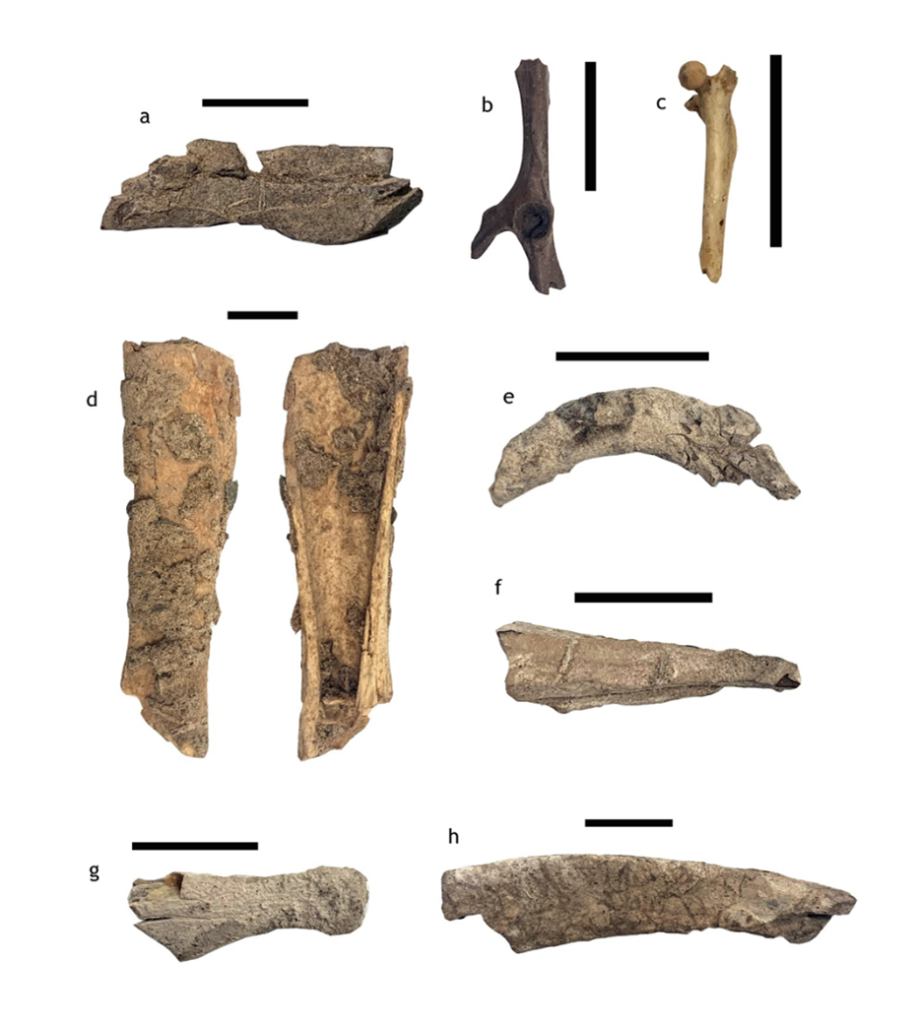
A special find at Warratyi is the partial radius (wrist bone) of a young diprotodontid found about 90 cm deep (Spit 18). Diprotodontids are a group of extinct, giant, quadrupedal marsupials. This bone is likely from the species, Diprotodon optatum (yumarti), but it is too fragmented to rule out other similar species. This is the first time the bone of a megafauna has been reported in association with human activity anywhere in Australia. At Warratyi, it is in the same layer as stone tools, other animal bones and red ochre. It is severely weathered and any bite or cut marks on it cannot be seen.
Surface marks
Most of the bones from Warratyi were small shards and fragments, but they do not follow the normal pattern for natural breakdown. Most likely they were broken deliberately. There were no tool marks on any bone from Warratyi, although many were severely weathered which may be masking these marks. Some tooth and corrosion marks show some bones were broken by carnivores or digested by birds. The tooth of a Tasmanian devil was found about 80 cm deep (Spit 16), as well as the remains quolls. These mean some of the bones were probably the prey of these carnivores.
Burn analyses
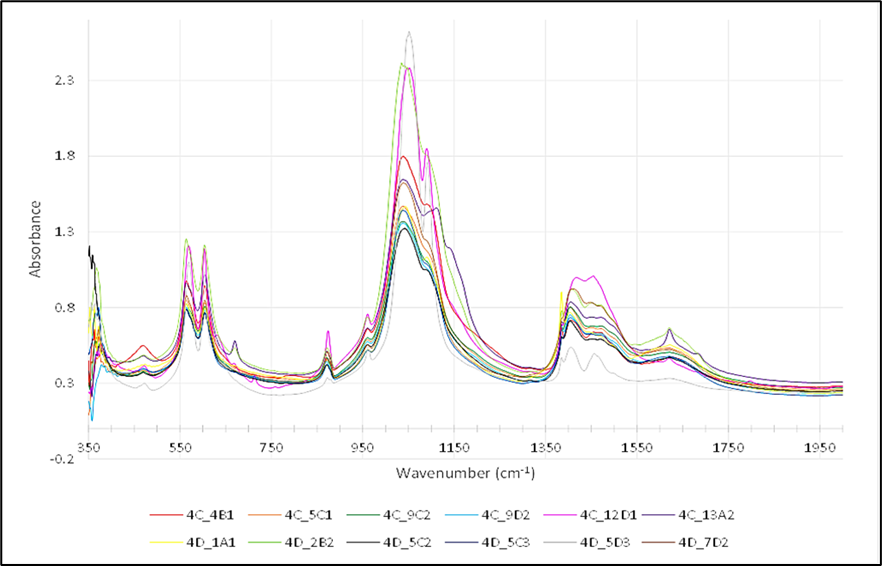
The bones across the deposit vary between shades of yellow, brown and white, but some are black and grey, showing they have been burnt. Preliminary tests on these burnt bones used infrared spectrometry to analyse how they were burnt. This technique uses a laser to analyse the molecular structure of the bone, and the spectrum it produces can indicate how this structure has been modified from its original state. Results suggest that several bones were burnt after the meat was removed and in relatively low temperature fires (less than 400°C). This could have been because heat from hearths in the shelter was affecting bones buried beneath them and/or small fires were used to dispose of bones when cleaning the shelter. It is unlikely that these burnt bones were from cooking.
Summary
The results from faunal analyses show that people, birds and mammalian carnivores were using Warratyi Rock Shetler repeatedly over a period of at least 40,000 years. It is likely that people would clear the space of debris from previous occupants somewhat regularly. There was a preferential selection of wallabies and kangaroos but supplemented with smaller resources like snakes. The fragmentation of the remains, small fires and presence of bone tools shows the shelter was also used to craft implements, rather than necessarily preparing and eating food. In the later part of the deposit, the abundance of avian-accumulated rodent remains suggests people may have used the shelter for shorter periods or less frequently, and it was cleared and trampled less intensely over time.
The animal bones at Warratyi are a record of how people and animals shared a space over time, as well as how people used animal remains for tasks other than subsistence. The materials and traditional knowledge together reveal the interconnected, strategic and long-lasting ways people lived in the area tens of thousands of years ago.